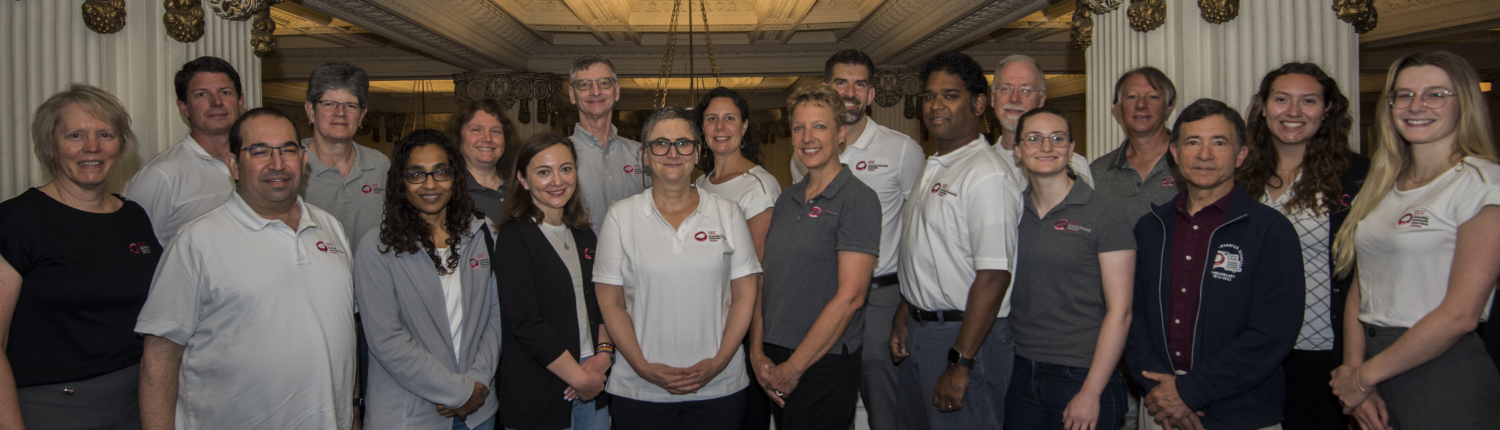
CCC Council

CCC Chair

Edward Lazowska*
University of Washington

CCC Vice Chair

Susan Graham*
University of California at Berkeley

CCC Director

Ann Drobnis*
Computing Research Association

CCC Program Associate

Kenneth Hines
Computing Research Association


Terms Ending - June 2015

Liz Bradley
University of Colorado at Boulder

Susan Davidson
University of Pennsylvania

Joseph Evans
University of Kansas

Ran Libeskind-Hadas
Harvey Mudd College

Shashi Shekhar
University of Minnesota

Terms Ending - June 2014

Deborah Crawford
Drexel University

Gregory Hager
Johns Hopkins University

Anita Jones
University of Virginia

John Mitchell
Stanford University

Bob Sproull
Oracle (ret.)

Josep Torrellas
University of Illinois at Urbana-Champaign

Terms Ending - June 2013

Randal Bryant
Carnegie Mellon University

Lance Fortnow
Georgia Institute of Technology

Eric Horvitz
Microsoft Research

Hank Korth
Lehigh University

Elizabeth Mynatt*
Georgia Institute of Technology

Fred Schneider*
Cornell University

Margo Seltzer*
Harvard University

* - Member of CCC Executive Committee


Ex-Officio

Andrew Bernat*
Computing Research Association, Executive Director

Past Members

Greg Andrews
University of Arizona

Bill Feiereisen
Department of Defense

Stephanie Forrest
University of New Mexico

Chris Johnson
University of Utah

M. Frans Kaashoek
Massachusetts Institute of Technology

David Kaeli
Northeastern University

Dick Karp
University of California at Berkeley
John King
University of Michigan

Peter Lee
Carnegie Mellon University

Andrew McCallum
University of Massachusetts

Robin Murphy
Texas A&M University

Daniel Reed
Microsoft

Karen Sutherland
Augsburg College

David Tennenhouse
New Venture Partners

Dave Waltz
Columbia University

Ed Lazowska

edEd Lazowska holds the Bill & Melinda Gates Chair in Computer Science & Engineering at the University of Washington. Dr. Lazowska received his A.B. from Brown University in 1972 and his Ph.D. from the University of Toronto in 1977, when he joined the University of Washington faculty. His research and teaching concern the design, implementation, and analysis of high performance computing and communication systems, and, more recently, the techniques and technologies of data-intensive science. Dr. Lazowska is a member of the National Academy of Engineering and a fellow of the American Academy of Arts & Sciences. He recently co-chaired (with David E. Shaw) the Working Group of the President's Council of Advisors on Science and Technology charged with reviewing the Federal Networking and Information Technology Research and Development Program. He is the chair of the Computing Community Consortium. Complete bio

Susan Graham

Susan GrahamSusan Graham is the Pehong Chen Distinguished Professor of Electrical Engineering and Computer Science Emerita at the University of California, Berkeley. She received the A.B. in mathematics from Harvard University and the Ph.D. in computer science from Stanford University. Her research spans many aspects of programming language implementation, software tools, software development environments, and high-performance computing. Dr. Graham is a member the National Academy of Engineering and a fellow of the Association for Computing Machinery, the American Association for the Advancement of Science, the American Academy of Arts and Sciences, and the Institute of Electrical and Electronics Engineers. Among her awards are the ACM SIGPLAN Career Programming Language Achievement Award (2000), the ACM Distinguished Service Award (2006), the Harvard Medal (2008), the IEEE von Neumann Medal (2009), the Berkeley Citation (2009), and the ACM/IEEE Ken Kennedy award (2011). She serves on the Harvard Corporation, the Board of Trustees of Cal Performances, and the Board of Overseers of the Curtis School of Music. Dr. Graham is the vice-Chair of the Computing Community Consortium. Complete bio

Liz Bradley

Liz BradleyLiz Bradley received the S.B., S.M., and Ph.D. degrees from the Massachusetts Institute of Technology in 1983, 1986, and 1992, respectively, including a one-year leave of absence to compete in the 1988 Olympic Games. She has been with the Department of Computer Science at the University of Colorado at Boulder since January of 1993; she also holds appointments and affiliations with a variety of engineering departments. Her current research activities focus on nonlinear dynamics and chaos, as well as scientific computation and AI. She is a member of Eta Kappa Nu, Tau Beta Pi, and Sigma Xi, as well as the recipient of a National Young Investigator award, a Packard Fellowship, and the 1999 College of Engineering teaching award. Complete bio

Randal Bryant

Randal BryantRandal E. Bryant is Dean of the Carnegie Mellon University School of Computer Science. He has been on the faculty at Carnegie Mellon since 1984, starting as an Assistant Professor and progressing to his current rank of University Professor of Computer Science. He also holds a courtesy appointment in the Electrical and Computer Engineering Department. Dr. Bryant's research focuses on methods for formally verifying digital hardware, and more recently some forms of software. His 1986 paper on symbolic Boolean manipulation using Ordered Binary Decision Diagrams (BDDs) has the highest citation count of any publication in the Citeseer database of computer science literature. In addition, he has developed several techniques to verify circuits by symbolic simulation, with levels of abstraction ranging from transistors to very high-level representations. Complete bio

Deborah Crawford

Deborah CrawfordDeborah Crawford is Vice Provost for Research at Drexel University. She received her Ph.D. in Information Systems Engineering from the University of Bradford and her B.Sc. (Hons) in Electronic and Electrical Engineering from the University of Glasgow, both in the United Kingdom. She joined Drexel in September 2010 after a seventeen-year career with the National Science Foundation. Deb has been active in the computing community for almost a decade. Her research contributions were in the areas of electronic and photonic nanostructures, vertical cavity surface emitting lasers, and high-speed photonic devices for high bandwidth communication applications. She published in these fields in former lives at the Jet Propulsion Laboratory, AT&T Bell Labs (Holmdel) and the University of California at Santa Barbara.

Susan Davidson

Susan DavidsonSusan B. Davidson is the Weiss Professor and Chair of Computer and Information Science at the University of Pennsylvania. She received the B.A. degree in Mathematics from Cornell University in 1978, and the M.A. and Ph.D. degrees in Electrical Engineering and Computer Science from Princeton University in 1980 and 1982. Her research interests span databases, web-based systems, and scientific data management. Dr. Davidson was the founding co-director of the Penn Center for Bioinformatics from 1997-2003, and the founding co-director of the Greater Philadelphia Bioinformatics Alliance. She holds a secondary appointment in the Department of Genetics, is an ACM Fellow, received the Lenore Rowe Williams Award (2002), and was a Fulbright Scholar and recipient of a Hitachi Chair (2004). She also served as Deputy Dean of the School of Engineering and Applied Science from 2005-2007. Complete bio

Joseph Evans

Joseph EvansJoseph B. Evans is the Deane E. Ackers Distinguished Professor of Electrical Engineering & Computer Science at the University of Kansas (KU). He has served as Director of the Information & Telecommunication Technology Center and as Director of Research Information Technology at KU, and as a Program Director at the National Science Foundation. He has been a researcher at the Cambridge University Computer Laboratory, Olivetti & Oracle Research Laboratory, USAF Rome Laboratories, and AT&T Bell Laboratories. He has co-founded several companies, including a network gaming company acquired by Microsoft in 2000 which formed the foundation for Xbox Live, and a defense-oriented venture acquired by General Dynamics in 2010 which developed TIGR, a tactical information system used worldwide by the US Army. His research interests include cognitive wireless networking, networked information systems architecture, and adaptive systems. He received the Ph.D. from Princeton University in 1989. Complete bio

Lance Fortnow

Lance FortnowLance Fortnow received his Ph.D. in Applied Mathematics at MIT in 1989 under the supervision of Michael Sipser. After two stints at the University of Chicago (spending four years at the NEC Research Institute in-between), Fortnow started as a Professor in the Electrical Engineering and Computer Science Department at Northwestern University in January of 2008. Fortnow also has a courtesy appointment at the Managerial Economics and Decision Sciences department at the Kellogg Graduate School of Management and an adjunct professorship at the Toyota Technological Institute - Chicago. Complete bio

Gregory Hager

Gregory HagerGregory D. Hager is a Professor and Chair of Computer Science at Johns Hopkins University and the Deputy Director of the NSF Engineering Research Center for Computer Integrated Surgical Systems and Technology. His research interests include time-series analysis of image data, image-guided robotics, medical applications of image analysis and robotics, and human-computer interaction. He is the author of more than 220 peer-reviewed research articles and books in the area of robotics and computer vision. In 2006, he was elected a fellow of the IEEE for his contributions in Vision-Based Robotics. Complete bio

Anita Jones

Anita JonesAnita Jones has served on the National Science Board, and chaired its Committee on Programs and Plans, which performs the Board's in depth evaluation of MREFC candidates. She is a member of the Defense Science Board and was the Director of Defense Research and Engineering. She, with NAE President Bill Wulf, formulated the notion of the Computer Science Grand Challenge Conferences as a community visioning exercise and chaired the first of the three conferences in this CRA and NSF sponsored series. Complete bio

Hank Korth

Hank KorthHenry F. Korth is Weiseman Professor of Computer Science and Engineering at Lehigh University. He is director of the Systems, Experimentation, and Analysis Laboratory for Databases (SEAL DB). His publications include three books, one of which, Database Systems Concepts, is soon to be in its sixth edition; over 100 journal articles, conference publications and other technical papers; and twelve book chapters. Korth also holds eight patents. Before his arrival at Lehigh, Korth held positions of leadership with Lucent Technology's Bell Laboratories in Murray Hill, N.J. Complete bio

Eric Horvitz

Eric HorvitzEric Horvitz is interested in principles of sensing, learning, and decision making under uncertainty. This includes human decision making and computational models of reflection and action. Beyond theoretical models, he pursues applications in several realms, including time-critical decision making, scientific exploration, information retrieval, and healthcare—with goals of understanding how computational models perform amidst real-world complexities, and of deploying valuable systems. Complete bio

Ran Libeskind-Hadas

Ran Libeskind-HadasRan Libeskind-Hadas is a professor of computer computer science and department chair at Harvey Mudd College. His research interests are in the area of algorithms, optical networking, and computational biology. He also works in the development of innovative undergraduate curricula in computer science. Libeskind-Hadas received the A.B. in applied mathematics from Harvard University and the M.S. and Ph.D. in computer science from the University of Illinois at Urbana-Champaign. Complete bio

John Mitchell

John MitchellJohn Mitchell is the Mary and Gordon Crary Family Professor in the Stanford Computer Science Department. His research focuses on web security, network security, privacy, programming language analysis and design, formal methods, and applications of mathematical logic to computer science. Over the past thirty years, Mitchell has written over 175 research articles and produced three books. He is Editor-in-Chief of the Journal of Computer Security, has served on the editorial board of eleven professional journals, and has served on the program committee of over 80 professional conferences. His past awards include a Director's Award from the U.S. Secret Service for his efforts in connection with the Electronic Crimes Task Force. Prof. Mitchell has managed research projects sponsored by AFOSR, DARPA, DHS, DHHS, NSF, ONR; he is the Stanford principal investigator for the TRUST NSF Science and Technology Center and Chief IT Scientist of the DHHS SHARPS project on healthcare IT security and privacy. Complete bio

Elizabeth Mynatt

Elizabeth MynattElizabeth Mynatt is a professor of Interactive Computing and the executive director of Georgia Tech's Institute for People and Technology. The Institute for People and Technology (IPaT) serves as a catalyst for research activities that pursue transformations in healthcare, media, education, and humanitarian systems by integrating advances in human-centered design, system science and engineering, policy, and management. Dr. Mynatt is an internationally recognized expert in the areas of ubiquitous computing, personal health informatics, computer-supported collaborative work and human-computer interface design. Named Top Woman Innovator in Technology by Atlanta Woman Magazine in 2005, Dr. Mynatt has created new technologies that support the independence and quality of life of older adults "aging in place," that help people manage diabetes, and that increase creative collaboration in workplaces. Dr. Mynatt is a member of the ACM SIGCHI Academy, a Sloan and Kavli research fellow, and serves on Microsoft Research's Technical Advisory Board. She is also a member of the Computing Community Consortium, an NSF-sponsored effort to engage the computing research community in envisioning more audacious research challenges. Dr. Mynatt earned her Bachelor of Science summa cum laude in computer science from North Carolina State University and her Master of Science and Ph.D. in computer science from Georgia Tech. Complete bio

Margo Seltzer

Margo SeltzerMargo Seltzer is the Herchel Smith Professor of Computer Science and a Harvard College Professor in the Harvard's School of Engineering and Applied Sciences. She received an A.B. degree in Applied Mathematics from Harvard/Radcliffe College in 1983 and a Ph. D. in Computer Science from the University of California, Berkeley, in 1992. She is the author of several widely-used software packages including database and transaction libraries and the 4.4BSD log-structured file system. Complete bio

Shashi Shekhar

Shashi ShekharShashi Shekhar is a McKnight Distinguished University Professor of Computer Science at the University of Minnesota, Minneapolis, USA. He was elected an AAAS Fellow as well as an IEEE Fellow and received the IEEE Technical Achievement Award for contributions to spatial databases, spatial data mining, and Geographic Information Sciences (GIS). He was also named a key difference-maker for the field of GIS by the most popular GIS textbook. His publications include 250+ refereed papers, a popular textbook on Spatial Databases and an authoritative Encyclopedia of GIS. Shashi is serving as a co-Editor-in-Chief of Geo-Informatica Journal (Springer), and a program co-chair for the Intl. Conference on Geographic Information Science (2012). He served on national academies committees (e.g., GEOINT Future Workforce (2011), Mapping Sciences (2004-2009) Priorities for GEOINT Research (2004-2005), and the Board of Directors of University Consortium on GIS (2003-2004). He also served as a general co-chair for the Intl. Symposium on Spatial and Temporal Databases (2011), and a member of editorial boards of IEEE Transactions on Knowledge and Data Eng. Shashi's research explores structure of very large geo-spatial computations. In 1990s, his research developed core technologies behind in-vehicle and web-based routing services, which transformed urban navigation. His recent results played a critical role in evacuation route planning for homeland security and received multiple recognitions including the CTS Partnership Award for significant impact on transportation. He also pioneered the research area of spatial data mining via pattern families (e.g. colocation, cascade), keynotes, survey papers and workshop organization. Complete bio

Fred Schneider

Fred SchneiderFred Schneider is the Samuel B. Eckert Professor of Computer Science at Cornell and chief scientist of the NSF TRUST Science and Technology Center. He serves on the CRA board of directors, the CCC council, co-chairs Microsoft's Trustworthing Computing Academic Advisory Board, and several journal editorial boards. He is a fellow of ACM, AAAS, and IEEE, was named Professor-at-Large at Univ of Tromso (Norway), and received a D.Sci honoris causa from University of Newcastle. Complete bio

Bob Sproull

Bob SproullRobert F. Sproull recently retired as Vice President and Director of Oracle Labs, an applied research group originated at Sun Microsystems. Since undergraduate days, he has been building hardware and software for computer graphics: clipping hardware, an early device-independent graphics package, page description languages, laser printing software, and window systems. He has also been involved in VLSI design, especially of asynchronous circuits and systems. Before joining Sun in 1990, he was a principal with Sutherland, Sproull & Associates, an associate professor at Carnegie Mellon University and a member of the Xerox Palo Alto Research Center. He is a coauthor with William Newman of the early text, "Principles of Interactive Computer Graphics." He is an author of the recently-published book "Logical Effort," which deals with designing fast CMOS circuits. He is a member of the National Academy of Engineering, a Fellow of the American Academy of Arts and Sciences, and has served on the US Air Force Scientific Advisory Board and as a technology partner of Advanced Technology Ventures.

Josep Torrellas

Josep TorrellasJosep Torrellas is the Director of the Center for Programmable Extreme-Scale Computing at the University of Illinois at Urbana-Champaign, and a Professor of Computer Science and (by courtesy) Electrical and Computer Engineering. He is a Fellow of IEEE and ACM. He is a former Chair of the IEEE Technical Committee on Computer Architecture, and a Willett Faculty Scholar at Illinois. He received a Ph.D. from Stanford University. He has made contributions to parallel computer architecture in the areas of shared-memory multiprocessor organizations, cache hierarchies and coherence protocols, thread-level speculation, and hardware and software reliability. He has graduated 27 PhD students, who are now leaders in academia and industry. He is currently engaged in research with Intel designing the Bulk Multicore architecture for programmability, and the Thrifty-Runnemede extreme-scale multiprocessor. He has lead the I-ACOMA multiprocessor project, and been involved in the DARPA-funded IBM-PERCS multiprocessor, and the Stanford DASH and Illinois Cedar machines. Complete bio


Bios of CCC Staff

Andrew Bernat

Andrew BernatAndrew Bernat was a founding member and chair of the Computer Science Department at the University of Texas at El Paso (spending 20 years there), NSF Program Director and is currently the Executive Director of the Computing Research Association, whose mission is to strengthen research and education in the computing fields, expand opportunities for women and minorities, and improve public and policymaker understanding of the importance of computing and computing research in our society. In recognition of "... his success in creating arguably the strongest computer science department at a minority-serving institution ...", the Computing Research Association honored him with the 1997 A. Nico Habermann Award. He has some 65 publications and (pre-CRA) over $5,000,000 in external funding.

Ann Drobnis

Ann DrobnisDr. Ann W. Drobnis is the Director of the Computing Community Consortium. Most recently, she was as Albert Einstein Distinguished Educator Fellow at the National Science Foundation working on education and workforce development issues for the CISE Directorate.  Ann spent most of her time working on the CS10K Project, whose goal is to get academically rigorous computer science courses into 10,000 high schools by 2016.  This is a much needed effort to create the research and workforce pipeline that our field so desperately needs.  Prior to her time at NSF, she taught high school computer science and math at Thomas Jefferson High School for Science and Technology.  She has a passion for broadening participation in computing, as her doctoral research was focused on ways to bring more females into the field.   

Kenneth Hines

Kenneth HinesKenneth Hines is a Program Associate at the Computing Community Consortium. He earned his master’s degree in applied research from the University of Maryland at Baltimore County in 2009. Previously, he received a bachelor’s degree in 2008 from Morgan State University. Previously, Kenneth was primarily responsible for data analysis on undergraduate and graduate computing students through the “Data Buddies” project with the Committee on the Status of Women in Computing Research (CRA-W). He also analyzes Ph.D. and postdoctoral data using a wide range of data sources, including NSF’s Survey of Doctorate Recipients (SDR) and CRA’s annual Taulbee survey, which gives valuable information about the enrollment, employment and salaries of recent Ph.D.s and faculty in computing departments throughout North America. As part of this work, Kenneth recently contributed to a white paper documenting statistics associated with academic and industry hiring, as well as the relevant issues about postdoctoral positions in the context of multiple stakeholders. Before working the Computing Research Association and the Computing Community Consortium, Kenneth worked on multiple projects with Johns Hopkins University and the American Academy of Pediatrics.